
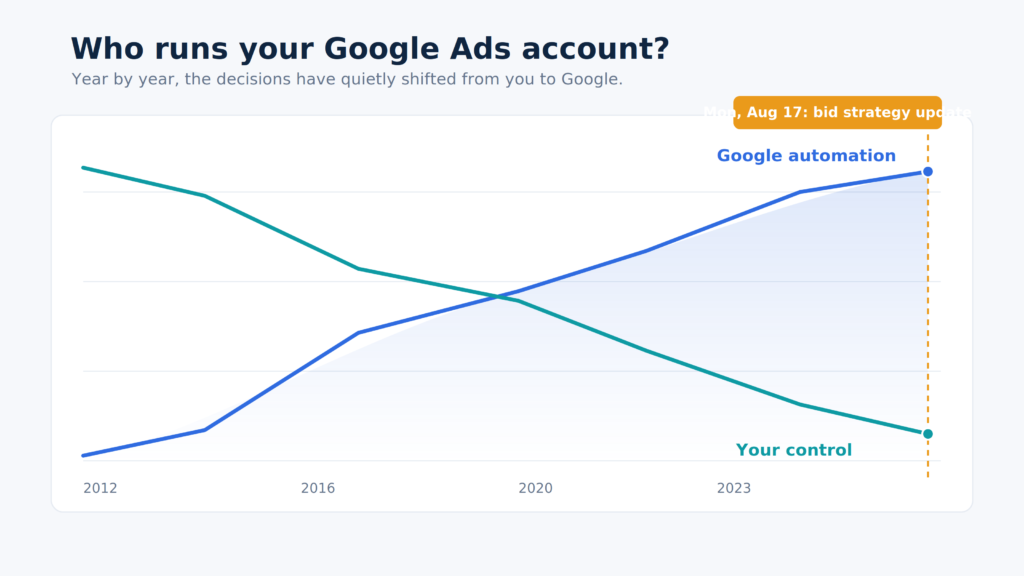
If you have managed Google Ads for any real length of time, you have watched the platform change underneath you so gradually that it is easy to miss how far it has actually moved. Not in the flashy, here-is-a-new-feature way. In the quiet, structural way. The way where you look up one day and realize the account you are managing operates on a completely different set of rules than the one you learned on. None of it arrived as a single dramatic announcement. It accumulated, one quiet change at a time, until the ground had moved completely.
On Monday, August 17, Google makes another one of these moves. And this one is a big deal, bigger than most of what came before it, because it does not just take another lever out of your hands. It changes the terms of the entire arrangement. The good news is that it is entirely manageable if you get ahead of it, so before we get to what happens Monday and what you should do about it, it is worth walking back through how we got here, because the change only makes sense as the latest step in a very long march.
The Long Handoff
Rewind to the manual bidding era and the job looked nothing like it does now. You set the bids. You set them by device, by location, by time of day. You segmented audiences to your heart’s content, sliced campaigns by match type, built single keyword ad groups so you could control relevance down to the individual term. You wrote ad schedules to protect budget on slow days. Every meaningful decision in the account was yours, and the platform mostly did what you told it to.
Then automation arrived, and to be fair, some of it worked. Smart Bidding could find efficiency that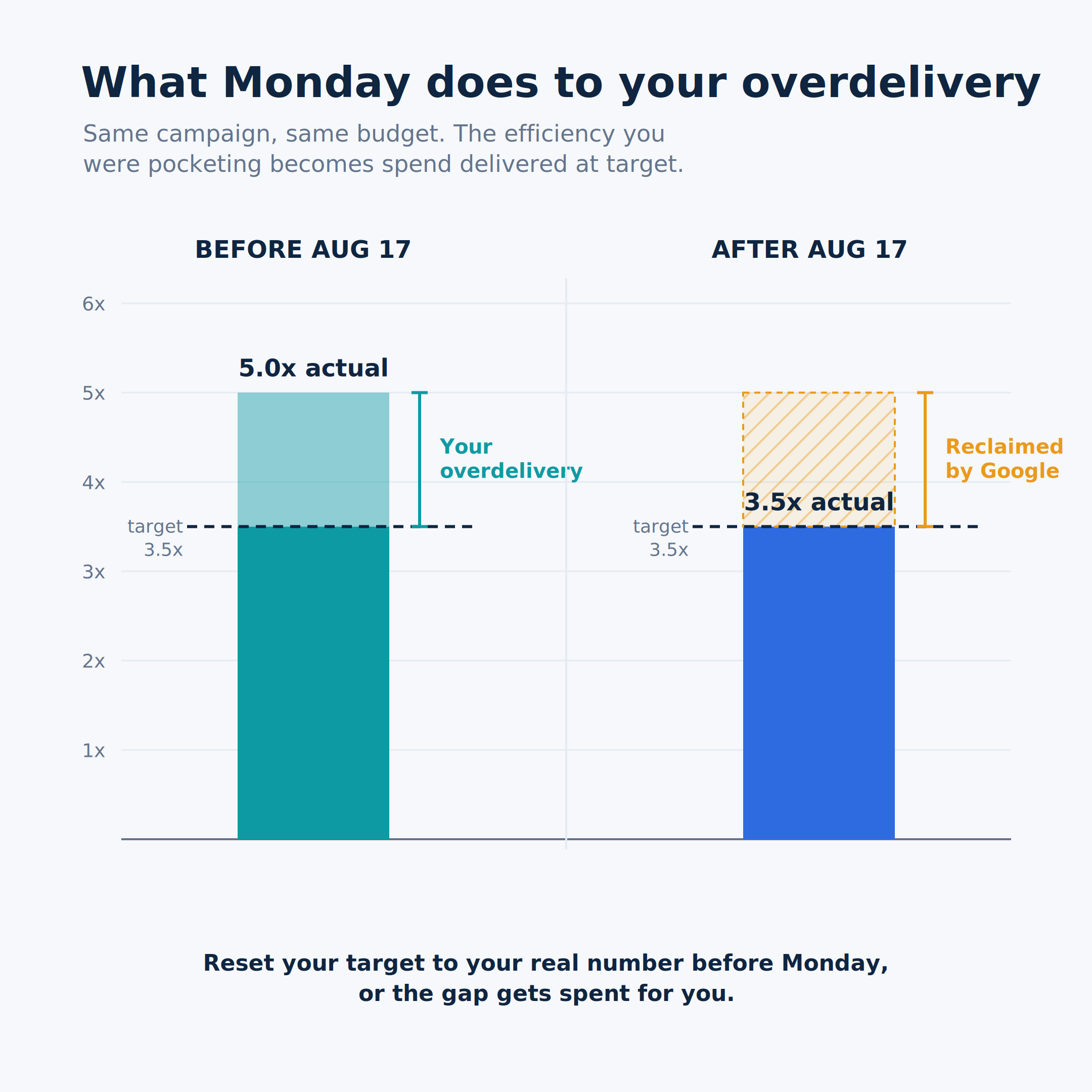 manual bidding, no matter how careful, simply could not. Plenty of the old manual tactics genuinely did stop earning their keep, and I said so at the time, back when I wrote about why SKAGS outlived their usefulness. At the time the trade felt reasonable. You gave up granular control, and in exchange the machine found performance you could not match by hand. That was the deal. Control for efficiency.
But that kind of deal has a quiet catch. Once the premise is that the machine knows best, every future decision defaults to Google instead of to you. So the levers kept leaving your hands, one at a time, each departure dressed up as a gift.
Match types stopped meaning what they said. Exact match stopped being exact. Close variants stopped being close. Phrase match loosened until it was barely a boundary at all. Every loosening was announced as smarter matching that would help you capture relevant traffic you were supposedly missing, and every one of them quietly transferred a little more control over intent from you to the system. You did the targeting. Google decided your targeting was a suggestion.
Broad match got pushed relentlessly at the same time, and that one had a price tag attached that nobody at Google likes to say out loud. More advertisers in more auctions means more competition, and more competition means higher CPCs. That is not a conspiracy theory, it is just how an auction works. The people who benefit from cramming more bidders into more auctions are not the bidders. And if you run brand campaigns, you felt this twice. Open your search terms report on any so-called brand campaign and you will find non-brand queries sitting right there, even against exact match brand keywords. Brand used to mean brand. You bid on your name, you showed up for your name, and if you wanted to appear for your exact brand term and nothing else, you could lock it down that way. That is gone. Match type erosion and the broad match push stopped letting brand stay brand, which means you are now paying more to defend your own name against traffic you never chose to bid on.
Then came the black boxes. Performance Max, where you feed in assets and budget and, for a long time, mostly took Google’s word for what happened inside. Getting any real visibility meant leaning on third party scripts just to see what the campaign was actually doing, until Google eventually started sharing more insights. And for all of it, Performance Max can be efficient, sure, but plain Shopping campaigns still beat it about half the time in my experience.
Then AI Max, getting pushed forward to replace Dynamic Search Ads, which was one of the genuinely efficient tools in the kit, retired before its replacement is anywhere near ready. Same pattern. A working thing gets swapped for something Google keeps far more opaque, the data harder to see, the mechanics harder to pin down, and the swap gets sold to you as progress. Worse, this one comes with a hook. AI search has swallowed a growing share of the Google real estate your ads used to compete for, and if you want to show up in those new placements, AI Max has to be enabled. So it is not really a choice. Either you sit those placements out entirely, or you opt into a campaign type that is not ready for primetime just to be present in them.
Look at all of it end to end and the direction never wavers. Every change moved a decision from your side of the table to Google’s. And through all of it, the justification held steady: trust the automation, because the automation delivers efficiency. That was the whole bargain. That was the thing that made giving up control feel worth it.
Which is exactly why Monday matters so much.
Why August 17 Is Different
Here is what changes on Monday, in plain terms.
Right now, if a campaign is limited by budget and running a target-based strategy like Target CPA or Target ROAS, Smart Bidding has been allowed to quietly overdeliver. It finds the most efficient auctions and beats the target you set. Your $10 target CPA has been coming in at $5. Your 4x ROAS has been landing at 5.5x. For a lot of accounts, that overdelivery has been running for months.
But that gap between target and actual was rarely an accident, and this is the part Google’s framing skips right over. For a lot of us, the gap was a lever we used on purpose.
Here is how target-based bidding actually behaves. The tighter your target, the more conservatively the system bids. Set it too aggressive, a ROAS too high or a CPA too low, and the algorithm gets picky, enters fewer auctions, and leaves your budget unspent. Loosen the target, a lower ROAS or a higher CPA, and it bids up, competes for more, and spends.
So if your real goal was a 5x ROAS but setting the target there left half your budget sitting on the table, you learned to set it looser, say 3.5x, specifically so the campaign would actually spend.
And here was the payoff. Inside a budget-limited campaign, the system would then cherry-pick the best auctions and overdeliver anyway, carrying your actual ROAS back up near that 5x. You got both. Full budget spent, and efficiency better than the number you typed in.
The gap was not sloppiness. It was the mechanism that let you use the target as a throttle for spend while still hitting the performance you were really after.
That is the trick that changes on Monday. Google calls the overdelivery a defect and closes the gap. The campaign hitting $5 against a $10 target drifts up toward $10, and Google’s own documentation uses that exact example, so this is not me being cynical.
What it means in practice: the loosened target you set to unlock spend becomes your real result. That 3.5x you only entered to spend the budget is now the ROAS you get. The overdelivery that carried you back to 5x is gone.
So you have a choice to make. Keep the loose target and accept its efficiency as your real number, or tighten the target toward your true goal and give up some of the spend and volume that came with the gap.
Sit with what that does to the bargain. For a decade the pitch was: give us control, and the machine will find you efficiency. Fine. Many of us took that deal with our eyes open. But now the machine finds the efficiency, and Google reaches over and spends it. The surplus that automation was supposed to hand you gets quietly redirected back into spend you never asked for. This is not another lever leaving your hands. This is the platform reneging on the reason you gave up the levers in the first place.
Here is the encouraging part though. The mechanics are simple, and so is the fix. The efficiency you built does not have to vanish on Monday. It just stops being automatic, which means the edge now goes to whoever actually pays attention. That can absolutely be you, and the rest of this article is how.
And if you want a small tell about how carefully this got rolled out, here it is. When the announcement dropped, I brought a handful of specific technical questions to Google, the kind you can only ask if you actually run accounts. Which timing was it optimizing on, click or conversion? How would it handle portfolio strategies? How would it read ad group targets that override the campaign? What happens in a volatile, high average order value account where ROAS swings hard on a few big orders? Every answer came back broad, vague, and cheerfully reframed as a good thing. I do not say that to pile on the reps, I have a whole other article for that. I say it because when the people sent to represent a change this significant cannot answer basic questions about how it works, that tells you something about how much care went into it, and whose interests it was built to serve.
So do not wait for Google to make this comfortable for you. It will not. It applies the change automatically, it will not touch your targets or your budgets on your behalf, and it leaves the cleanup entirely on your desk. Here is how to handle it.
How to Actually Prepare
Find the campaigns that are beating their targets. This whole thing only bites the overperformers. Pull your budget-limited campaigns running Target CPA or Target ROAS, and compare each target to its last 30 days of actual performance. The ones delivering well inside their target are the ones about to drift. The ones already sitting at or above target are fine. Make the list before the weekend is out.
Reset the target toward your actuals, at the level where the target actually lives, and do it in steps. For a campaign hitting $5 against a $10 target, moving the target down toward $5 preserves what you had. Two traps to avoid. First, where you make the edit. If your strategy is a portfolio, the default target lives at the portfolio level, not on the campaign. And if any ad groups carry their own target overrides, those supersede whatever the strategy sets, campaign or portfolio, so an edit at the strategy level never touches them and those ad groups will drift anyway. Fix the target wherever the operative one actually sits. Second, do not swing it all at once. Move the target toward your actual in increments over a few adjustments rather than one big jump, because large sudden changes can throw a strategy that has been running smoothly into a relearning period you do not want right now.
Take extra care with high AOV accounts. If a handful of large orders can swing your ROAS dramatically, then your 30 day actual might be propped up or dragged down by a few outlier sales rather than reflecting what the account does on a normal day. Do not anchor your new target to a distorted number. Pull a longer, more representative window, set aside the obvious anomalies, and base the target on typical performance instead. Then move toward it in steps, checking as you go, exactly as above.
Do not overreact to the first few days. Performance will wobble as the system settles, especially anywhere with a long conversion cycle. That early noise is not signal. Resist the urge to make a second round of changes off it, and give it a conversion cycle or two before you judge anything.
Resist the reflexive levers. Do not slap on bid caps or data exclusions as a panic response. Google advises against it and it tends to create more volatility, not less. And this is a bad week to kick off a major migration, like moving to value-based bidding, right on top of the change. Let one thing settle before you start another.
Decide what you actually want, on purpose. Here is the real choice in front of you. If you would genuinely take more volume at a slightly looser efficiency, then this change is not stealing anything from you, it is just forcing a conversation about your targets that was probably overdue. Set the target where your real goal is and own it. If Maximize Conversions or Maximize Conversion Value fits the account better than a target you keep babysitting, this is a fine moment to make that call deliberately. The point is that the number should reflect a decision you made, not a default Google drifted you into.
Then expect the next one. The real lesson of the last decade is that the platform will keep changing underneath you, and the drift always runs in the same direction. This update will not be the last curveball Google throws, so the advantage goes to whoever sees the next one coming.
The Bottom Line
None of this means ripping out Smart Bidding or distrusting every tool in the platform. The tools still perform when you hold them to your terms instead of Google’s. The deal just shifted, and you are the one who has to catch it when it does. Check your targets against actuals, question any number that moves on its own, and get in there before Monday.

